

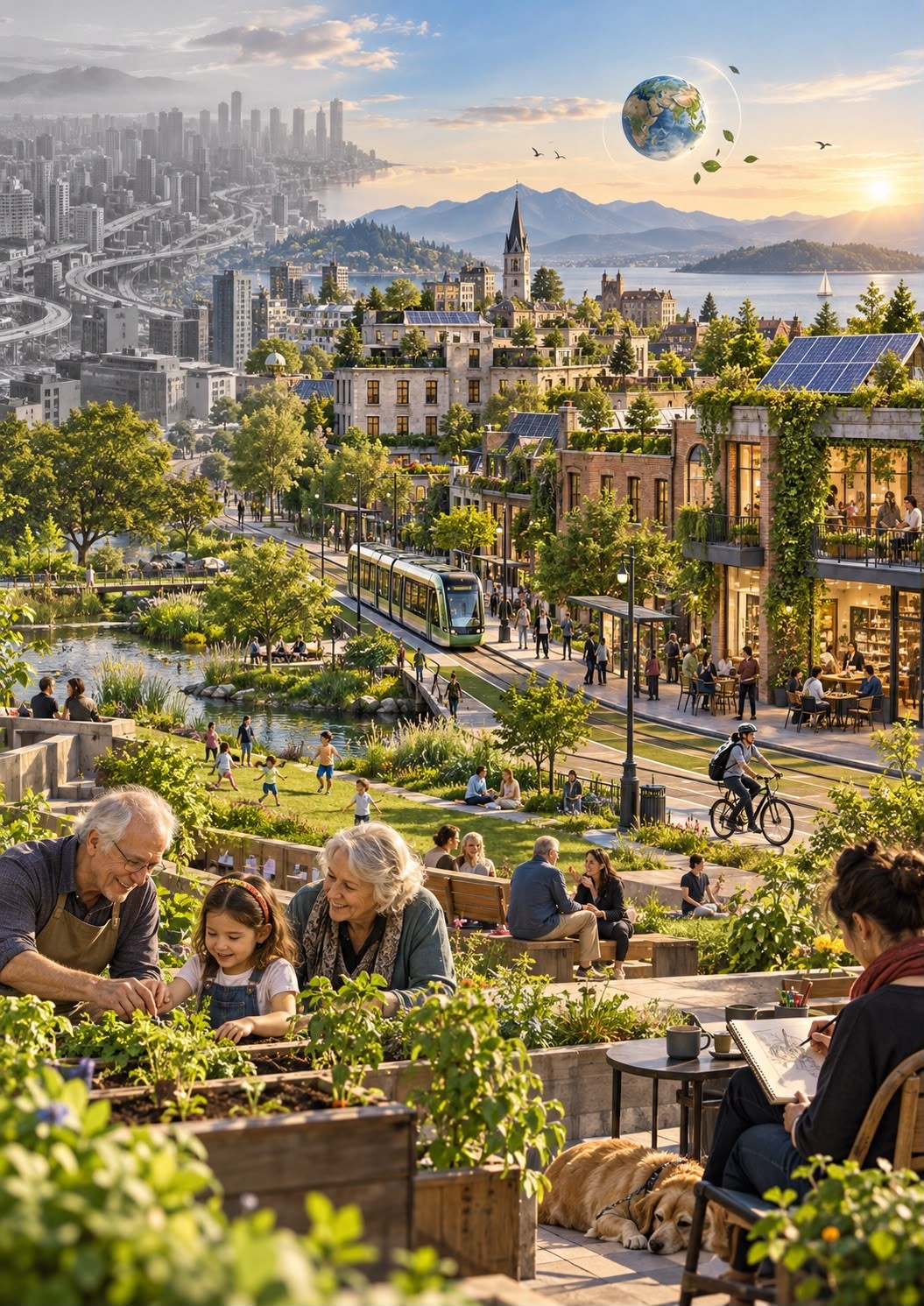

Rethinking Growth, Sustainability and Quality of Life in the Age of Population Decline
By Sándor Haberman
For decades, population growth and economic expansion have been regarded as essential indicators of national success. Governments have sought higher birth rates, larger workforces, increased production and continuously rising GDP. A declining population, by contrast, is generally presented as a warning sign — a threat to prosperity, economic stability and the future of society.
But what if we approached this challenge from a different perspective?
What if, instead of concentrating almost exclusively on reversing population decline, we learned to accept it as a demographic reality and explored how to build a better, more sustainable and fulfilling life within this new framework?
This does not mean celebrating population decline or ignoring its difficulties. It means recognizing that a smaller population does not necessarily have to mean a poorer society.
Beyond the Obsession with GDP
Consider a simple arithmetic relationship. If a country’s GDP remains unchanged while its population decreases by 10%, GDP per capita increases by approximately 11%.
Of course, this mathematical improvement does not automatically translate into greater individual prosperity. Income distribution, productivity, employment and the costs of supporting an aging population remain critical factors.
Nevertheless, it raises an important question: should the success of a society be measured primarily by the total volume of goods and services it produces, or by the quality of life its citizens enjoy?
Perhaps the central economic ambition of the 21st century should not be endless quantitative expansion, but the intelligent use of existing resources.
Education, healthcare, cultural opportunities, environmental quality, affordable housing and personal freedom should become increasingly important measures of progress.
Economic growth can contribute to these objectives, but it should be regarded as a means rather than an end in itself.
An Opportunity for Environmental Sustainability
A gradually declining population could create opportunities to reduce pressure on natural resources, land, water supplies and ecosystems.
Fewer people may eventually require fewer new buildings and roads, and less investment in other infrastructure. Lower demand for certain resources could make environmental protection and ecological restoration easier.
However, population decline alone will not stop climate change or environmental degradation.
Technological innovation, cleaner energy systems, responsible consumption and more sustainable production methods remain essential. Governments must continue supporting environmental research while introducing effective legislation, regulations and economic incentives.
The opportunity lies in combining demographic change with deliberate environmental policies.
Instead of using technological progress exclusively to produce and consume more, we could increasingly use it to reduce environmental damage and improve the efficiency of what we already have.
More Time for Living
Modern societies frequently measure success through economic output, consumption and productivity. Yet human fulfillment extends far beyond these indicators.
Time for family, creativity, sports, travel, cultural activities, education and community life contributes enormously to individual well-being.
A society less dependent on continuous quantitative expansion might choose to distribute some of the benefits of technological progress through shorter working hours and greater personal freedom.
Naturally, slower economic growth does not automatically create more leisure time.
Higher productivity, fairer distribution of economic benefits, flexible working arrangements and thoughtful social policies would all be necessary.
The objective should not be to work less at the expense of essential services, but to organize economic activity so that greater efficiency also improves people’s everyday lives.
Rethinking the Role of Older Generations
One of the most serious challenges of population decline is the growing proportion of elderly citizens.
Fewer working-age people will need to support increasingly demanding pension, healthcare and long-term care systems.
This challenge cannot be dismissed. However, our understanding of aging also needs to evolve.
Many older people remain physically active, intellectually engaged and capable of contributing meaningfully to society long after traditional retirement age.
Flexible employment, part-time professional activities, mentoring, education and community participation could help older generations remain active for longer.
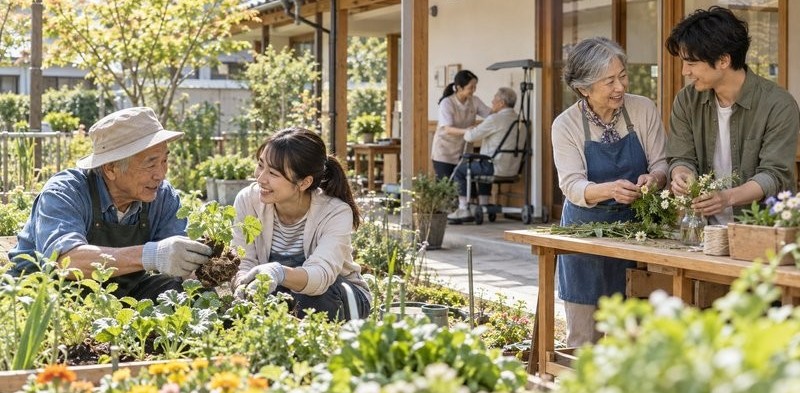
Japan shows what this can look like in practice. In 2023, a record 9.14 million people aged 65 and over were in employment, and employment rates reached all-time highs in every older age group. Municipal Silver Human Resources Centers match retirees with short-term local work, from gardening and childcare support to clerical tasks, giving many older people both an income and a continuing role in their communities.
Their experience could also contribute to childcare, intergenerational learning and family support, provided such involvement remains voluntary and does not replace professional care where it is needed.
Rather than treating older citizens primarily as an economic burden, we should recognize their knowledge, experience and continuing social potential.
At the same time, societies must invest in accessible healthcare, prevention and dignified long-term care for those who need support.
Japan has also invested heavily in care technology, from lifting aids to monitoring sensors. Its experience suggests that such tools can ease the physical burden on care workers, but they cannot replace human care.
Better Cities Instead of Endless Construction
As an architect and urban development professional, I see particularly significant opportunities in the built environment.
For decades, urban development has often been associated with expansion: more buildings, more roads, more infrastructure and the continuous consumption of additional land.
But declining populations invite us to reconsider this approach.
Budapest offers an interesting example.
According to Hungary’s 2022 census, approximately 160,000 of the capital’s housing units were classified as unoccupied, although this category also includes properties used for purposes other than permanent residence.
Meanwhile, Habitat for Humanity Hungary has highlighted the serious shortage of affordable housing across Hungary, estimating that hundreds of thousands of families need across to low-cost rental accommodation.
This contrast raises an important question: before continuously expanding our cities, should we not make better use of the buildings we already possess?
Renovation, adaptive reuse, incentives to bring vacant properties into residential use, and affordable rental housing programs could improve living conditions while reducing unnecessary construction and resource consumption.
Not every unoccupied property is suitable or available for housing. Nevertheless, better management of the existing building stock should become a central objective of urban policy.
Japan illustrates both the scale of the problem and possible responses. Its 2023 Housing and Land Survey counted a record 9 million vacant dwellings, 13.8% of the national housing stock, a share strikingly close to Hungary’s 13%. About 3.86 million of these homes were neither for sale nor for rent; many have simply been left unused. In response, hundreds of municipalities run “akiya banks” that match vacant houses with new residents, and since 2015 national legislation has allowed local authorities to require owners to repair or demolish neglected properties.
The same principle applies to public infrastructure. Schools, community facilities, parks and transport systems should increasingly be planned around quality, accessibility and changing demographic needs rather than automatic expansion.
Here, too, Japan offers useful lessons. For some two decades, the city of Toyama has concentrated housing, shops and services along its light rail and bus corridors, a compact-city strategy the OECD highlighted in 2012. And as pupil numbers have fallen, Japan closed 8,850 public schools between 2004 and 2023. Nearly three-quarters of the closed school buildings still standing have been given new lives as community centers, offices, welfare facilities, workshops or visitor accommodation.
Supporting Families While Accepting Demographic Reality
Accepting population decline does not mean opposing childbirth or discouraging families from having children.
Quite the opposite.
Families should receive meaningful support, and every child should have access to high-quality education, healthcare, cultural opportunities and a safe, healthy environment.
The objective should be to create a society in which people can freely make decisions about parenthood without unnecessary economic or social obstacles.
A child’s opportunities and well-being matter at least as much as national birth statistics.
Supporting families and preparing for a smaller population are not contradictory objectives. Responsible governments should pursue both.
A New Roadmap for the 21st Century
The transition toward a potentially smaller, older population requires more than demographic forecasts.
It calls for a new kind of cooperation among economists, policymakers, architects, urban planners, environmental scientists, healthcare professionals and educators.
Together, they should develop a long-term roadmap for societies that may no longer experience continuous population growth.
Such a roadmap should prioritize environmental sustainability, efficient use of existing resources, intergenerational solidarity, high-quality public services and opportunities for meaningful individual lives.
As the examples above suggest, Japan, one of the countries furthest along in the demographic transition, could play an important role in developing and testing these approaches. Other aging societies, including Hungary and many other European countries, could learn from its experience while contributing their own solutions.
We should not confuse accepting demographic reality with surrendering to it.
Perhaps the greatest challenge of the 21st century is not how to produce more, consume more and grow endlessly, but how to live better with what we already have.
A smaller society can still aspire to a richer life.
And that may be a more meaningful definition of progress.
Sándor Haberman, MSc in Architecture, is a Hungarian architect and senior real estate development and project management professional with decades of international experience. His interests include sustainable urban development, demographic change, housing and the relationship between economic development and quality of life.
Related Artices:
A New UN Report Calls for Living in Balance with The Planet
Overtourism: Civil Society Mobilising
Forty Years of the ‘Right to Development’: When Growth Excludes, Is It Still Development?