


By Thalif Deen
UNITED NATIONS (IPS) – The revenues from arms sales and military services by the 100 largest arms-producing companies rose by 5.9 per cent in 2024, reaching a record $679 billion, according to new data released by the Stockholm International Peace Research Institute (SIPRI).
Global arms revenues rose sharply in 2024, as demand was boosted by the wars in Ukraine and Gaza, global and regional geopolitical tensions, and ever-higher military expenditure.
For the first time since 2018, all of the five largest arms companies increased their arms revenues, according to SIPRI, one of the authoritative sources for arms sales and global military spending.
Currently, a rash of armed conflicts and civil wars are taking place in Ukraine, Gaza, Myanmar, Sudan, Iraq, Libya, Morocco, Syria, Yemen, Haiti, Democratic Republic of the Congo (DRC), Somalia and Western Sahara, among others, triggering a rising demand for arms from governments and rebel forces.
Although the bulk of the global rise was due to companies based in Europe and the United States, there were year-on-year increases in all of the world regions featured in the Top 100. The only exception was Asia and Oceania, where issues within the Chinese arms industry drove down the regional total, according to SIPRI
The surge in revenues and new orders prompted many arms companies to expand production lines, enlarge facilities, establish new subsidiaries or conduct acquisitions.
‘Last year global arms revenues reached the highest level ever recorded by SIPRI as producers capitalized on high demand,’ said Lorenzo Scarazzato, Researcher with the SIPRI Military Expenditure and Arms Production Programme.
‘Although companies have been building their production capacity, they still face a range of challenges that could affect costs and delivery schedules.’
Of the 26 arms companies in the Top 100 based in Europe (excluding Russia), 23 recorded increasing arms revenues. Their aggregate arms revenues grew by 13 per cent to $151 billion. This increase was tied to demand stemming from the war in Ukraine and the perceived threat from Russia.
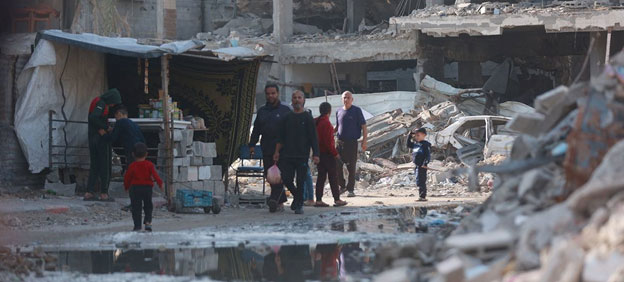
But the rise in arms revenues and military spending also had a devastating impact on civilians, with a rise in death tolls.
As of mid-to-late November 2025, the Gaza Health Ministry reported that over 70,000 Palestinians, mostly civilians, have been killed in the war since October 7, 2023.
But estimates of the death toll in the Russia-Ukraine war vary widely and are difficult to verify, as both sides consider military casualty figures to be state secrets.
Still, the number of Russian military casualties (dead and wounded) is estimated by sources like the UK Ministry of Defense and the Center for Strategic and International Studies (CSIS) to be over 1 million, a “stunning and grisly milestone”.
Ukrainian military casualties (killed and wounded) are estimated at approximately 400,000.
Norman Solomon, executive director, Institute for Public Accuracy and author of “War Made Invisible: How America Hides the Human Toll of Its Military Machine,” told IPS the business of war is the business of lucrative death, and never more so than in 2025.
“The buyers and sellers of high-tech weaponry are in a macabre embrace, and the results can be found on the battlefield, in civilian suffering, and in the less-obvious carnage of depleted resources as children starve while profiteers feast.”
The United States stands out as the world’s biggest arms merchant. No other country comes close. And in recent years, when it comes to putting armaments to aggressively lethal use, Russia has become a standout with its war in Ukraine and Israel has become a standout with its war in Gaza, said Solomon, who is also national director, RootsAction.
“It should be clearly understood that U.S. weapons makers have been deriving tremendous profits from the Ukraine war and from Israel’s genocidal war on Gaza. Those profits will continue as long as the mutual destruction of Ukrainian and Russian lives continues, and as long as Israel maintains its policies of destroying the lives of Palestinian civilians’.
“In a world where several countries are major arms exporters, all of whom should be condemned for their activities, the United States is far and away the leader in murderous commerce,” he pointed out.
The fact that the U.S. excels at such commerce is a marker for a moral corruption built into the country’s political economy and power structure of governance. Opposition movements, nonviolent and determined, will be essential to forcing an end to what Martin Luther King Jr. called “the madness of militarism,” he declared.
Dr Simon Adams, international human rights expert and President and CEO of the Center for Victims of Torture, told IPS in this new age of impunity, increased conflict and creeping authoritarianism in so many parts of the world, there has been a sickening increase in global arms sales.
The guns, drones, missiles and other weapons are coming from the major arms manufacturing countries and companies, but it is civilians in Ukraine, Gaza, Sudan and elsewhere who pay with their lives, he said.
“There is a direct correlation between the increase in the global arms trade, and the fact that 123 million people are currently displaced in the world – the highest number since the Second World War.”
“We need governments to invest more in humanitarian solutions to global problems, not spend billions of dollars more every year on the manufacture and marketing of shiny new killing machines.”
“I long for the day when the arms trader will be seen like the slave trader, sex trafficker or drug dealer – as an international outlaw and pariah. As someone involved in an immoral criminal enterprise that is antithetical to human progress,” he declared.
Asked for a response, UN Spokesperson Stephane Dujarric told reporters December 1 about the
“obscene amount of money that is going to weapon sales compared to the struggle that we face every single day trying to fund our humanitarian operations”.
“We understand that Member States need to defend themselves and need for military. But I think, if you do a compare and contrast the amount of money that is flowing into that sector as opposed to the amount of money that is being sucked out of the humanitarian and development sectors, it should give us all food for thought,” he declared.
Meanwhile, in 2024 the combined arms revenues of US arms companies in the Top 100 grew by 3.8 per cent to reach $334 billion, with 30 out of the 39 US companies in the ranking increasing their arms revenues, according to SIPRI.
These included major arms producers such as Lockheed Martin, Northrop Grumman and General Dynamics.
However, widespread delays and budget overruns continue to plague development and production in key US-led programmes such as the F-35 combat aircraft, the Columbia-class submarine and the Sentinel intercontinental ballistic missile (ICBM).
Several of the largest arms producers in the US are affected by overruns, raising uncertainty about when major new weapon systems and upgrades to existing ones can be delivered and deployed.
‘The delays and rising costs will inevitably impact US military planning and military spending,’ said Xiao Liang, Researcher with the SIPRI Military Expenditure and Arms Production Programme.
‘This could have knock-on effects on the US government’s efforts to cut excessive military spending and improve budget efficiency.’
INPS Japan/ IPS UN Bureau Report