
By Ahmed Fathi
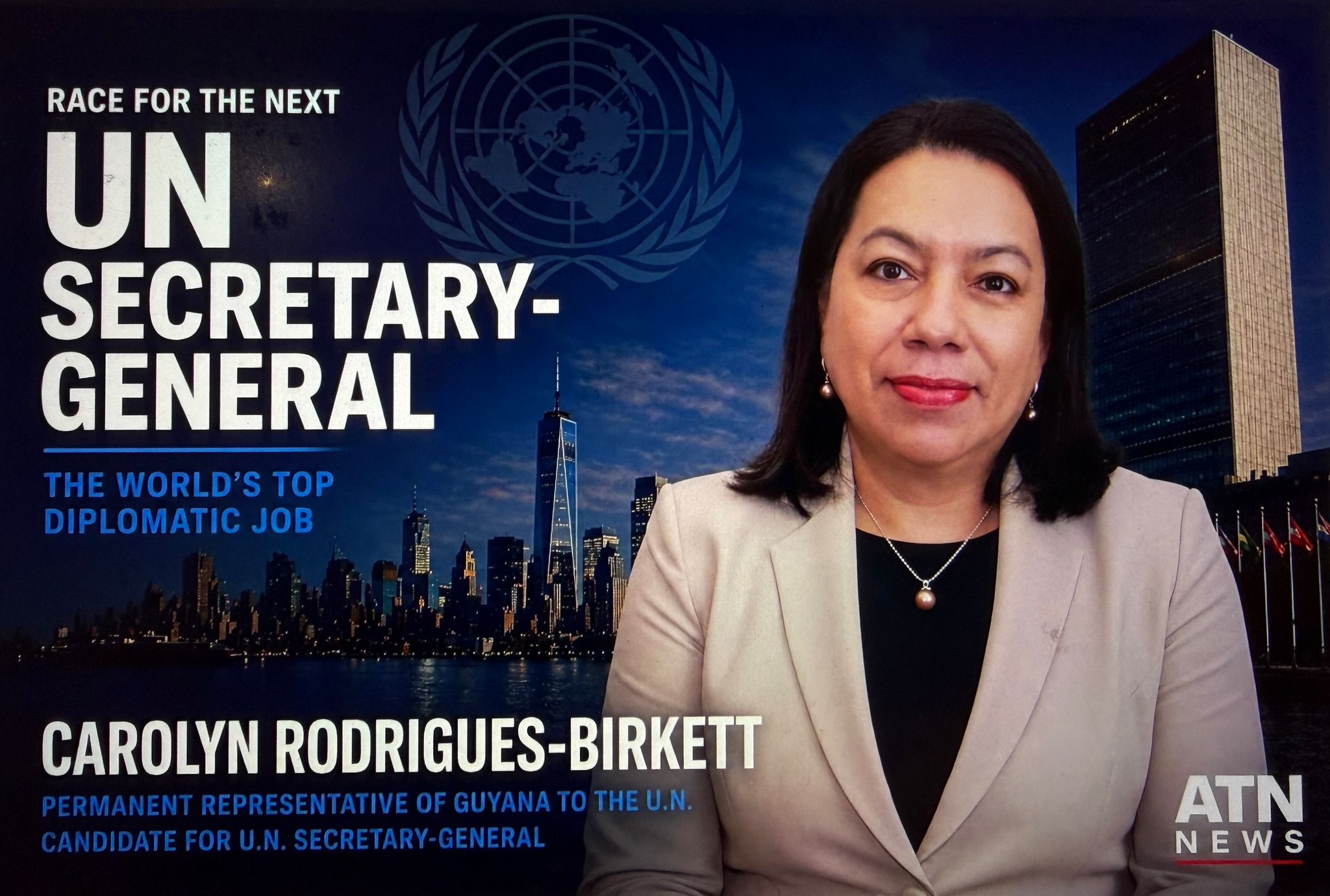
UNHQ, New York(INPS Japan/ATN)- Carolyn Rodrigues-Birkett, Guyana’s candidate for the next U.N. secretary-general, used her interactive dialogue with member states to make a careful case for practical reform, Charter discipline, and a more trusted United Nations at a time when the organization is being tested by war, financial pressure, and public doubt.|JAPANESE|
Carolyn Rodrigues-Birkett did not present herself as a disruptive candidate. Her argument was more measured: the U.N. remains indispensable, but it must become more effective, more present, and more honest about what it can deliver.
Her pitch rested on three ideas: reasserting the principles of the U.N. Charter, reforming the organization’s systems, and rallying member states behind delivery across peace and security, development, and human rights.
It was a small-state message with a practical edge. Rodrigues-Birkett, Guyana’s permanent representative to the U.N. and a former foreign minister, framed her candidacy through the experience of countries that depend on multilateral rules not as decoration but as survival.
She repeatedly returned to one clear line: the secretary-general’s only bias should be toward the Charter and international law. That formulation gave her answers and discipline, especially when delegations pressed her on Ukraine, Gaza, human rights, and Security Council paralysis.
The dialogue tested how she would handle the central problem facing the next secretary-general: how to lead an organization whose mandates keep expanding while political unity, money, and patience are shrinking.
On peace and security, Rodrigues-Birkett argued that the secretary-general must be proactive, use good offices, engage parties directly, and work with regional and subregional organizations. Asked how the U.N. can avoid being seen as absent or late, she said she would seek openings for progress and would not fear rejection or failure.
That was one of her stronger moments. It suggested a candidate who understands that the secretary-general cannot command peace but can still create political space.
On Article 99 of the Charter, which allows the secretary-general to bring threats to international peace and security before the Security Council, she was cautious. Rodrigues-Birkett said the secretary-general must gather information from the field, assess humanitarian consequences, engage parties, and use available channels before deciding whether to invoke it. That answer was legally careful and politically safe, but it may disappoint those who believe the next U.N. chief must confront the Council more directly when it is blocked.
Ukraine, speaking with Lithuania and Poland, raised war crimes, attacks on civilians, deportation of children, sexual violence, and the problem of a permanent Council member using the veto. Rodrigues-Birkett answered that every violation of the Charter and international law places responsibility on the secretary-general to highlight the issue, but she said those principles must apply to all conflicts.
The answer avoided a direct confrontation with Russia. That may be smart campaign diplomacy. It also showed the limits of her cautious approach.
The Arab Group pressed her on double standards in international law, the Palestinian question, humanitarian access, and support for U.N. bodies, including UNRWA. Rodrigues-Birkett said she would work with all relevant parties to uphold international humanitarian law, ensure humanitarian access, and support a long-term solution, noting the many Security Council and General Assembly resolutions on the issue.
Again, the answer was balanced but restrained. She recognized the core issues but did not offer a new mechanism or political red line. Her approach was consistent: stay anchored in the Charter, avoid theatrical promises, and leave room for diplomacy.
On human rights, the European Union challenged her on the imbalance between the U.N.’s three pillars and the limited share allocatedsources going to human rights. Rodrigues-Birkett said that investment in development and peace and security is also an investment in human rights. She cited her work in Guyana on Indigenous education and Indigenous rights as evidence that rights-based policy can produce measurable development gains.
That answer reflected one of her natural strengths. She speaks most comfortably about human rights through dignity, inclusion, and development. That may resonate with many Global South delegations. But civil society groups and some Western states may still look for a more forceful public voice when governments themselves are violating rights.
Her strongest ground was development finance, climate vulnerability, and small-state priorities.
The Group of 77 and China pressed her on the 2030 Agenda, development financing, geographic representation, and the risk that U.N. reform could weaken development mandates. Rodrigues-Birkett said the world faces an implementation deficit, not a shortage of commitments, and called for stronger engagement with international financial institutions and reform of the global financial architecture.
Small island developing states, CARICOM, the Pacific Islands Forum, and the Maldives pushed her on climate vulnerability, the Antigua and Barbuda Agenda for SIDS, the multidimensional vulnerability index, and the links between climate and security. Rodrigues-Birkett said U.N. work with small island states must align with their agreed priorities and that tools such as the vulnerability index should be pushed more strongly with financial institutions.
She also made the issue personal, saying she comes from a country where high tides are not an abstract climate talking point. It was one of the few moments when biography and policy aligned naturally.
On U.N. reform, Rodrigues-Birkett embraced the UN80 process but warned that efficiency must not become another word for weakening delivery to the most vulnerable. She said the secretary-general must provide member states with clear information about the consequences of proposed reforms, especially where development gains could be reversed.
This may be one of her strongest political positions. Major donors want a leaner U.N. Developing countries fear cuts dressed up as modernization. Rodrigues-Birkett tried to occupy the middle ground: reform the machine, but do not quietly remove the engine.
On Security Council reform, the African Group asked how she would support permanent African representation and correct what African states describe as a historic injustice. Rodrigues-Birkett said there is broad agreement that the Council must be reformed, including recognition of Africa’s special case. But she emphasized that negotiations belong to member states and that the Secretariat’s role is to support the process.
After the dialogue, Rodrigues-Birkett told reporters she did not consider herself a late entrant because the process remains open and more candidates may still come forward. She said the decision required consultations with her family and confirmed that she plans to visit capitals to seek support.
Asked whether she entered because something was missing from the field, she rejected that framing, saying the Security Council and wider membership should have as many candidates as possible and that Latin America and the Caribbean have qualified people to offer.
Her performance helped define her candidacy. Rodrigues-Birkett is not running as the loudest voice in the field. She is running as a practical multilateral diplomat from a small developing state, with government experience, U.N. experience, and a development-first understanding of global vulnerability.
Her strengths are clear: she knows the U.N. room, understands member-state sensitivities, and can speak to reform without sounding reckless. Her vulnerabilities are also clear. On the most politically explosive issues, she often stayed at the level of principle and process.
Rodrigues-Birkett made a credible case that she understands the institution and the moment. The next test is whether capitals see in her not only a safe pair of handsbut also the nerve to lead a U.N. being asked to do more with less money, less unity, and less patience from the world it claims to serve.
INPS Japan/ATN